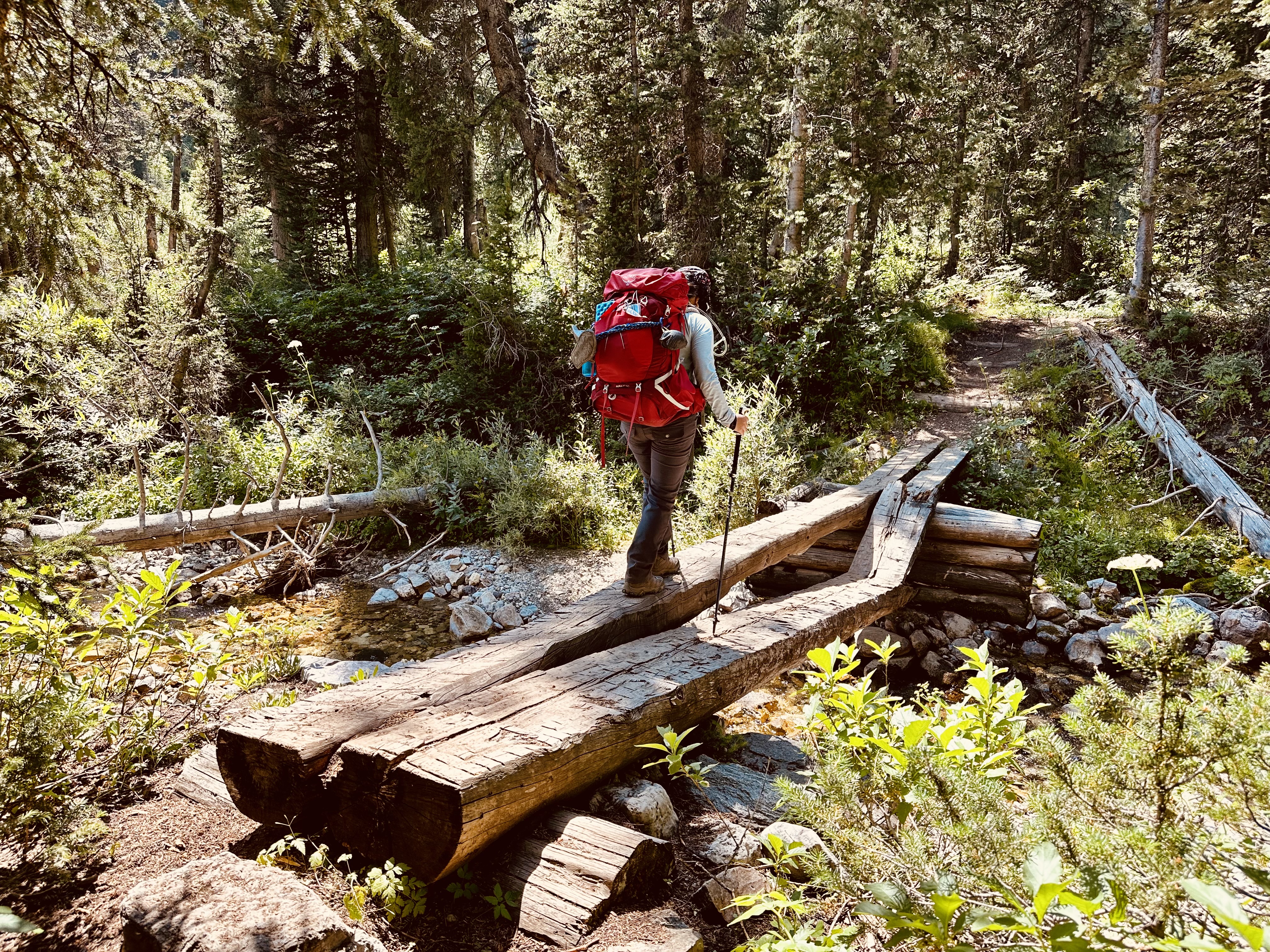
In preparation for backpacking season, here’s a few things to think about before your first backpacking trip!
1. It’s going to be challenging, but avoid signing up for something impossible or dangerous.
While I firmly believe it’s a good idea to challenge yourself (if that’s what you’re looking for), it’s also important to make sure you’re doing something that is reasonable. It’s worth doing your research in advance to make sure that the trip you’re about to do is something within your physical abilities and that you know what you’re getting into beforehand. If it’s your first time ever, I’d suggest going with a friend who’s done it before, or finding a guided tour that’s your speed.
2. If you have to carry in water, know what you’re doing in advance. And make sure you’re able to carry that much weight.
Water is heavy, as it turns out (this is something of an inside joke – I was working with a colleague on a test cell involving a column of water, and I commented on the pressure reading at the bottom of the column being higher than I’d expected. He pointed out that water is, indeed, heavy – and it was a taller column than I’d realized).
There’s lots of places in the mountains up North that are great for having water along the trail (Colorado is particularly excellent), which makes things much easier. If you’re really feeling like something dry (think Big Bend) is in the cards for you, it’s really important that you both know how much water you need for hiking with a heavy pack in a hot, arid climate. You also really need to make sure that you’re able to carry a pack that heavy. Remember, “a pint’s a pound the world around,” so that 3L water bladder is over 6.5 lb! That’s a lot, and it really adds up quickly when you consider how much water you need in a day plus the water you need for rehydrating your meals. I’ve also found that when I’m carrying a heavier pack, I need more water…so it’s kind of a circular problem.
The bottom line: make sure you know both how much water you need and that you’re able to carry it before you embark on a journey into a dry climate without water.
3. You’ll probably have to poop in the woods. But it’s not that bad, I promise.
Wondering what gear you’ll need to go to the bathroom in the woods? Check out my packing list here!
In the woods, you’ll need to either dig a cathole at least 6″ deep or use a wag bag. It’s important to stay far away from both water sources and the trail; the restrictions vary by location, so check the rules for where you’re heading beforehand.
Basically, you’ll need to use a small shovel to dig a hole, then you go in that hole (be sure to aim), and then you cover it back up. There’s varying opinions on what you do with TP. Some folks think you can bury it with your business, but others think you should pack it out. I won’t weigh in on that argument here, but I tend to use wipes and pack them out. Wipes feel less nasty to pack out than TP, for some reason.
For women, you may also want something to wipe when you pee. Again, check out my packing list, but you have a few options here – either you use a Kula cloth or you can pack out some higher quality TP (don’t use biodegradable TP for this…it will disintegrate in your hands, and that’s just gross!). If you’re going to have to pack it out anyway, you might as well use better TP, but a Kula cloth really is convenient.
4. You probably won’t sleep well.
At least, I have yet to figure this one out. You’ll be exhausted, tired, and sore, and you’ll want nothing more than to sleep. Even with the best sleep setup (again, check out my packing list!), you probably won’t sleep great.
I don’t have any magical solutions here. It’s just the way things go. But your first night back in the “real world,” you’ll sleep like a baby, and it will be the best thing ever, even if you’re on a lumpy mattress in a cute but outdated mountain town motel.
5. You will be gross. And you will feel gross.
And you will probably smell.
If your days end at a water source (which mine tend to, intentionally) and it’s warm out, consider going for a swim to wash yourself off after your hike!
Pro tip: if you brought a summit beer, you can also put your beer in the water to help cool it down.

If going for a swim is not an option for you, then…well…you’ll be kind of gross. And that’s ok. No one is out there in the woods to judge you.
If you’re worried about getting your sleeping bag gross, you can always use a sleeping bag liner. There are tons of great options here (I have a warm weather option and a cold weather option that adds a lot of warmth to my sleep setup!) and they’re all washable, which is awesome. Side note: if you get a silk liner, it may not be super washable. I washed Jerry’s silk sleeping bag liner after many years of many uses (you can’t imagine what it smelled like) and it…didn’t survive. RIP, in more ways than one.
You can also take a set of base layers to sleep in. It will feel nice to put on some clean clothes, and the base layers will keep you warm at night. Plus, these same clothes can give you some extra warmth during the day if it ends up being colder than expected!
You can also take a wipe (either an extra of your bathroom wipes, or a face wipe, or a body wipe) to clean up at the end of the day. I like to take something to clean my face at the end of the day – otherwise, my face tends to break out. After “washing” my face, I’ll use that wipe for the rest of me, such as it is.
6. You will probably be slower than usual, but that’s ok.
I’m pretty short (5′ 1″), and when I’m wearing a backpack, my stride is shorter than usual. I usually take pretty big steps for a short person, as I’ve been told on more than one occasion, but that’s not the case when I’m carrying a heavy backpack. Something between the extra weight on my waist/hips and the waist strap of my pack shorten my stride, resulting in me being slower than usual.
And here’s the thing – that’s ok.
It’s not a race. The journey is the designation, or whatever cheesy office poster slogan you want to use. The point is to do something different and get out in nature, not be the fastest person ever. If you’re actually trying to be the fastest person ever, good for you! But I’m probably not the right person to follow for the inside scoop on FKTs (Fastest Known Times).
I like my delightfully slow pace. It allows me to enjoy the scenery and get out of my own head a bit.
7. You don’t have to buy a bunch of expensive gear to get started.
Particularly if it’s your first trip! Figure out what matters to you, and go from there. And if you’re not sure this backpacking thing is your jam, find a place to rent gear! Lots of universities and outdoor gear stores have rental programs you can use. Or you can borrow gear from a friend. Or you can go with a friend who has all the right gear, and use their shared gear (but be sure to offer to help carry some of the shared equipment!).
There are also lots of lower cost options too. For example, if you love REI but the prices are a bit too high for you, wait for their big sales, or check out Backcountry. Moosejaw used to be a great option, but apparently they went out of business (noooooo!). Steep and Cheap is also a great option, but their inventory is a bit inconsistent.
8. Be prepared for most things, but don’t over prepare for anything.
This one takes some time to figure out. You want to make sure you have enough multi-functional items (for example, a buff for warmth and/or sun protection that can also be a headband), but not so much gear that it weighs you down.
Make sure you always have the 10 essentials and the right gear to cover you for all likely situations (for example, in the mountains in the summer, you’ll probably need a raincoat). But you don’t need to cover all available scenarios – for example, you probably don’t need your tinfoil hat to protect you in the event of an alien abduction. If you get abducted while backpacking, you’ll probably have to let your new green friends read your mind. Sorry about that – you can hold me personally accountable for any consequences.
Aiming for multifunctional gear can help you be prepared for a wide range of situations. For example, sleeping in your baselayer can help you be comfortable at night and save weight by being warm extra layers during the day. For more details, check out my moderately light backpacking packing list!
9. Most importantly – HAVE FUN!
This is the most important part – enjoy yourself. If you’re not having fun, it’s ok to bail and try again on a different trip.
Oh, and be safe.
Happy trails!

Leave a Reply